
loess avtivities


The Italian LOESS Summer Camp, designed and run in May 2025 by Controvento and the University of Brescia, involved 29 young people from the Garibaldi-Da Vinci State Technical Institute in Cesena. During the four-day seminar, trainers proposed hybrid forms of teaching, alternating in-depth lectures on soil with non-formal activities aimed at constructing a conceptual map of the soil, practical scientific activities in the city analysing soil, mapping activities with the LOESS crowd-mapping app, and future exercises. The experience concluded with an event that brought young people together to share the results of their study and engage in dialogue with local, regional and international policy makers. Members of the Italian LOESS Community of Practice participated in the final event. The Italian event merged with the LOESS International Summer Camp in September 2025.
“LOESS – Literacy boost through an Operational Educational Ecosystem of Societal actors on Soil health” is a European project that promotes awareness and understanding of the importance of soil, its health and functions across Europe through the development of educational offerings, in-service training programmes and skills development activities aimed at educational actors, stakeholders and the public.
Controvento and the Primary School Dante Alighieri of Cesena celebrated World Soil Day 2024 by reflecting on war, peace and sustainability and spending a morning in the name of pedagogical innovation and peace education. On 5 December, the world celebrated World Soil Day, one of the most complex and least known, most contested and least protected resources on which the survival of ecosystems and human societies depends. In the context of LOESS, a Horizon project in which Controvento is a partner, class 5A participated in a national widespread event dedicated to the theme of ‘Soil and Wars, Soils and Peace’.
“LOESS – Literacy boost through an Operational Educational Ecosystem of Societal actors on Soil health” is a European project that promotes awareness and understanding of the importance of soil, its health and functions across Europe through the development of educational offerings, in-service training programmes and skills development activities aimed at educational actors, stakeholders and the public. It is funded by the Horizon Europe Programme in the framework of the EU Mission ‘A Soil Deal for Europe’.
“LOESS – Literacy boost through an Operational Educational Ecosystem of Societal actors on Soil health” is a European project that promotes awareness and understanding of the importance of soil, its health and functions across Europe through the development of educational offerings, in-service training programmes and skills development activities aimed at educational actors, stakeholders and the public. It is funded by the Horizon Europe Programme in the framework of the EU Mission ‘A Soil Deal for Europe’.
LOESS meets the project

The School is the City: Planting Trees, Growing Knowledge.
Following Professor Stefano Mancuso’s call to plant one trillion trees by 2030, students and teachers from the G. Carducci Primary School in Cesena took action. Two hundred children planted two hundred young trees in Parco dell’Ippodromo, helping to heal the wounds left by the May 2023 flood and contributing to the restoration of local biodiversity.
Italy, school year 2023-24. The Centre for Education for Sustainability of the Municipality of Ravenna, which is part of the Network of Education for Sustainability of the Emilia Romagna Region, proposes to the Primary Schools of Ravenna an educational path dedicated to the discovery of the resource ‘water’ and its saving. Controvento Società Cooperativa Sociale, a LOESS partner, implements it.
Climate change is already a reality: rising temperatures, more frequent extreme events, increasingly fragile territories. Cities, although occupying only 3% of the world’s land, are home to over half of the population and consume most of the resources. This is where the challenge of resilience comes into play.
The Climate and Resilience project, promoted by the CTR education for sustainability ARPAE Emilia-Romagna, was created to support municipalities, schools and local communities in addressing the impacts of climate change. The activities are carried out in the area by the CEAS – Centres for Education for Sustainability – through training courses, innovative tools and participatory activities. This video recounts the encounter between the experience of the CEAS in Ravenna, which has translated the project’s objectives into concrete actions – observing, understanding and acting to build safer, more liveable and sustainable cities – and that of the Horizon Europe LOESS project, which focuses on soil health, even in cities, as a key factor in mitigating global warming. Because being resilient means being ready. Together.
The series “LOESS Meets the Project…” was created within the Horizon Europe LOESS project through the encounter with members of the Italian Community of Practice and their initiatives.
STORIES FROM THE SUBSOIL
Within the Italian Community of Practice of the Horizon Europe project LOESS, the idea was born to collect the stories of those working to protect soil health. Thus the series entitled ‘Stories from the Subsoil’ took shape. The first video is dedicated to Luca Novelli, writer of science books for kids.
Within the Italian Community of Practice of the Horizon Europe LOESS project, the idea was born to collect the stories of those working to protect soil health. Thus the series entitled ‘Stories from the Subsoil’ took shape. The second video is dedicated to Paolo Pileri, professor at the Politecnico di Milano, who works on soil protection and ecological planning
Within the Italian Community of Practice of the Horizon Europe LOESS project, the idea was born to collect the stories of those working to protect soil health. Thus the series entitled ‘Stories from the Subsoil’ took shape. The third video is dedicated to Annibale Biggeri, epidemiologist, who talks about soil pollution, impact on public health and sense of community
Within the Italian Community of Practice of the Horizon Europe LOESS project, the idea was born to collect the stories of those working to protect soil health. Thus the series entitled ‘Stories from the Subsoil’ took shape. The fourth video is dedicated to Mario Neve, Professor of Geography at the Department of Cultural Heritage at the University of Bologna. In part 1 of the video, Professor Neve talks about landscape, soil and the importance of integrating scientific knowledge and knowledge of professional communities in order to explain the complexity of soil.
Within the Italian Community of Practice of the Horizon Europe LOESS project, the idea was born to collect the stories of those working to protect soil health. Thus the series entitled ‘Stories from the Subsoil’ took shape. The sixth video is dedicated to Mario Neve, Professor of Geography at the Department of Cultural Heritage at the University of Bologna. In part 2 of the video, Professor Neve discusses soil, forests and the need for science to take into account the complexity of ecosystems..
Within the Italian Community of Practice of the Horizon Europe LOESS project, the idea was born to collect the stories of those working to protect soil health. Thus the series entitled ‘Stories from the Subsoil’ took shape. The sixth video is dedicated to Mario Neve, Professor of Geography at the Department of Cultural Heritage at the University of Bologna. In part 3 of the video, Professor Neve discusses soil and landscape memory.
Within the Italian Community of Practice of the Horizon Europe LOESS project, the idea was born to collect the stories of those working to protect soil health. Thus the series entitled ‘Stories from the Subsoil’ took shape. The seventh video is dedicated to Raffaele Pignone, a geologist. At the beginning of his career, geologist Raffaele Pignone devoted himself to fundamental pedological and geological studies aimed at understanding the nature of soils and the climatic history of the Po Valley. Through the analysis of soils, sediments, and their stratification, Pignone reconstructed the evolution of the natural processes that shaped the plain, the role of rivers, glaciations, and climate change, and the deep connection between soil, climate, and landscape. These studies made it possible to interpret the territory as a natural archive, capable of telling the story of thousands of years of environmental transformations. A pioneering body of work that helped clarify how the Po Valley is the dynamic result of the interaction between geology and climate over time.
public events
LOESS – заједно за здраво земљиште На овом панелу разговараћемо о стању земљишта код нас и о различитим иницијативама за његово очување. Зашто је здраво земљиште важно? Како њиме управљамо и како чувамо његове посебности? Колико је земљиште данас угрожено и које све мере можемо предузети за његову заштиту? Какво образовање нам је потребно за повећање свести о овим питањима? Панел сe одржава као једна од активности пројекта LOESS у Србији (https://loess-project.eu/).
LOESS – zajedno za zdravo zemljište Na ovom panelu razgovaraćemo o stanju zemljišta kod nas i o različitim inicijativama za njegovo očuvanje. Zašto je zdravo zemljište važno? Kako njime upravljamo i kako čuvamo njegove posebnosti? Koliko je zemljište danas ugroženo i koje sve mere možemo preduzeti za njegovu zaštitu? Kakvo obrazovanje nam je potrebno za povećanje svesti o ovim pitanjima? Panel se održava kao jedna od aktivnosti projekta LOESS u Srbiji (https://loess-project.eu/).
Datum i vreme: ponedeljak, 23. decembar, 18 časova Lokacija: Naučni klub CPN-a, Kralja Petra 46, Beograd
Centar za promociju nauke krajem meseca organizuje dve tribine u saradnji sa Poljoprivrednim i Šumarskim fakultetom Univerziteta u Beogradu. Glavna tema oba događaja je značaj zemljišta, njegov uticaj na našu svakodnevicu, ali i izazovi očuvanja ovog dragocenog resursa.
Prva tribina se fokusira na ulogu zemljišta u ekosistemu i kako ga možemo očuvati.
Ova tribina održava se kao jedna od aktivnosti projekta LOESS u Srbiji (https://loess-project.eu/).
Razgovaraju:
prof. dr Aleksandar Đorđević, Poljoprivredni fakultet Univerziteta u Beogradu doc. dr Lazar Kaluđerović, Poljoprivredni fakultet Univerziteta u Beogradu prof. dr Svjetlana Radmanović, Poljoprivredni fakultet Univerziteta u Beogradu dr Nataša Nikolić, Ministarstvo poljoprivrede, šumarstva i vodoprivrede
Moderira:
dr Jelena Bogosavljević Lipovac, Poljoprivredni fakultet Univerziteta u Beogradu
Tribine se održavaju u decembru, mesecu posvećenom podizanju svesti o značaju zemljišta, s obzirom na to da se 5. decembra širom sveta obeležava Svetski dan zemljišta. Ovaj datum nas podseća na ključnu ulogu zemljišta kao temelja života na planeti i pruža priliku da se kroz ovakve stručne diskusije osvetle izazovi njegove zaštite i održivog upravljanja.
Druga tribina istražuje izazove degradacije zemljišta i kako oni utiču na budućnost razvoja društva.
Ova tribina održava se kao jedna od aktivnosti projekta LOESS u Srbiji (https://loess-project.eu/).
Razgovaraju:
dr Olivera Košanin, Šumarski fakultet Univerziteta u Beogradu
Merita Borota, Ministarstvo poljoprivrede, šumarstva i vodoprivrede
Vanja Šimunić, Republički geodetski zavod
Anita Pavković, Hemijsko-prehrambena tehnološka škola
Moderiraju:
Danica Borota, studentkinja 4. godine Šumarskog fakulteta
Iskra Ložaić, studentkinja 4. godine Šumarskog fakulteta
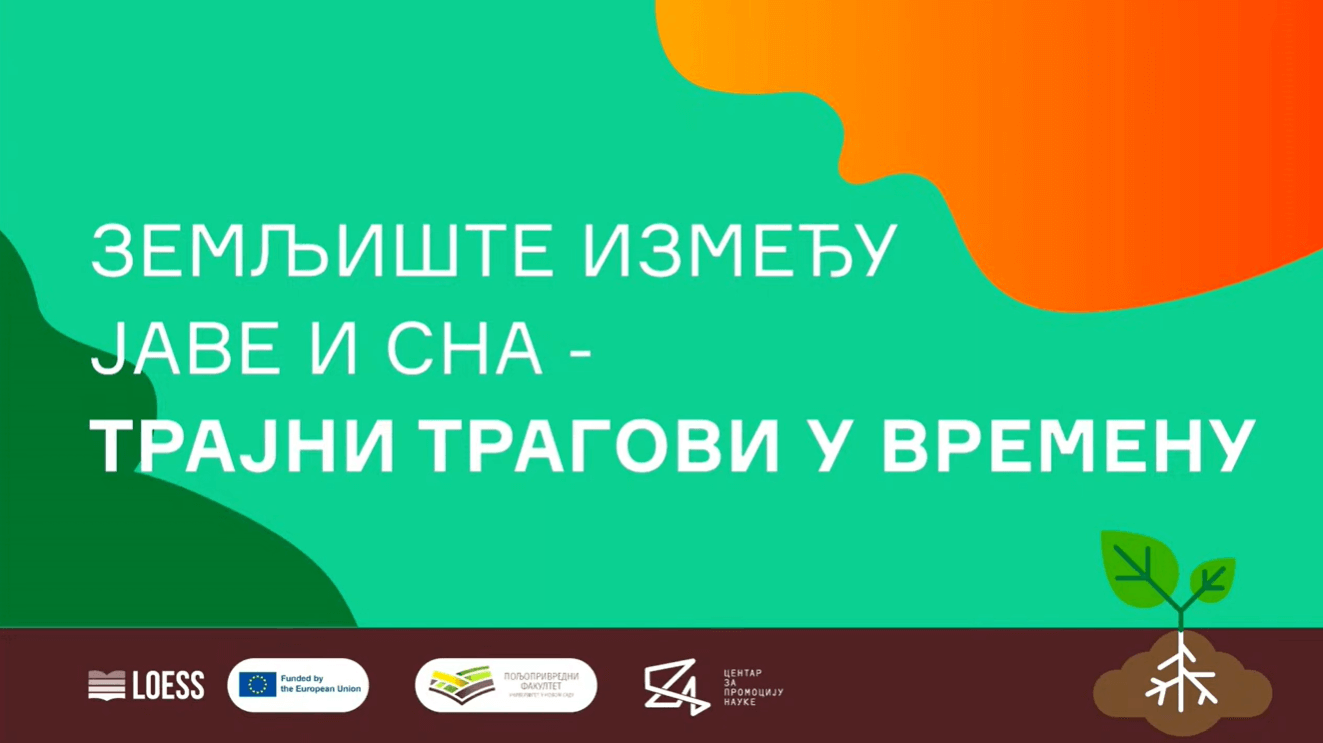
Treća tribina o zemljištu realizuje se u saradnji sa Poljoprivrednim fakultetom Univerziteta u Novom sadu.
Koliki je pritisak čovek svojim delovanjem izvršio na zemljište iz ugla poljoprivrede? Koja je uloga svakog pojedinca u budućnosti u buđenju svesti o značaju i ulozi zemljišta? Pridružite nam se u razgovoru o ovim važnim pitanjima.
Ova tribina održava se kao jedna od aktivnosti projekta LOESS u Srbiji (https://loess-project.eu/).
Moderira: Doc. dr Bojan Vojnov, Poljoprivredni fakultet Univerziteta u Novom Sadu
Razgovaraju:
Prof. dr Srđan Šeremešić, Poljoprivredni fakultet Univerziteta u Novom Sadu (naučna oblast Agroekologija)
Prof. dr Borivoj Pejić, Poljoprivredni fakultet Univerziteta u Novom Sadu (naučna oblast Navodnjavanje)
Prof. dr Vladimir Ćirić, Poljoprivredni fakultet Univerziteta u Novom Sadu (naučna oblast Pedologija)
Dr Jovica Vasin, Institut za ratarstvo i povrtarstvo Novi Sad (naučna oblast Pedologija)