
Case study: Stepping Stones Forests
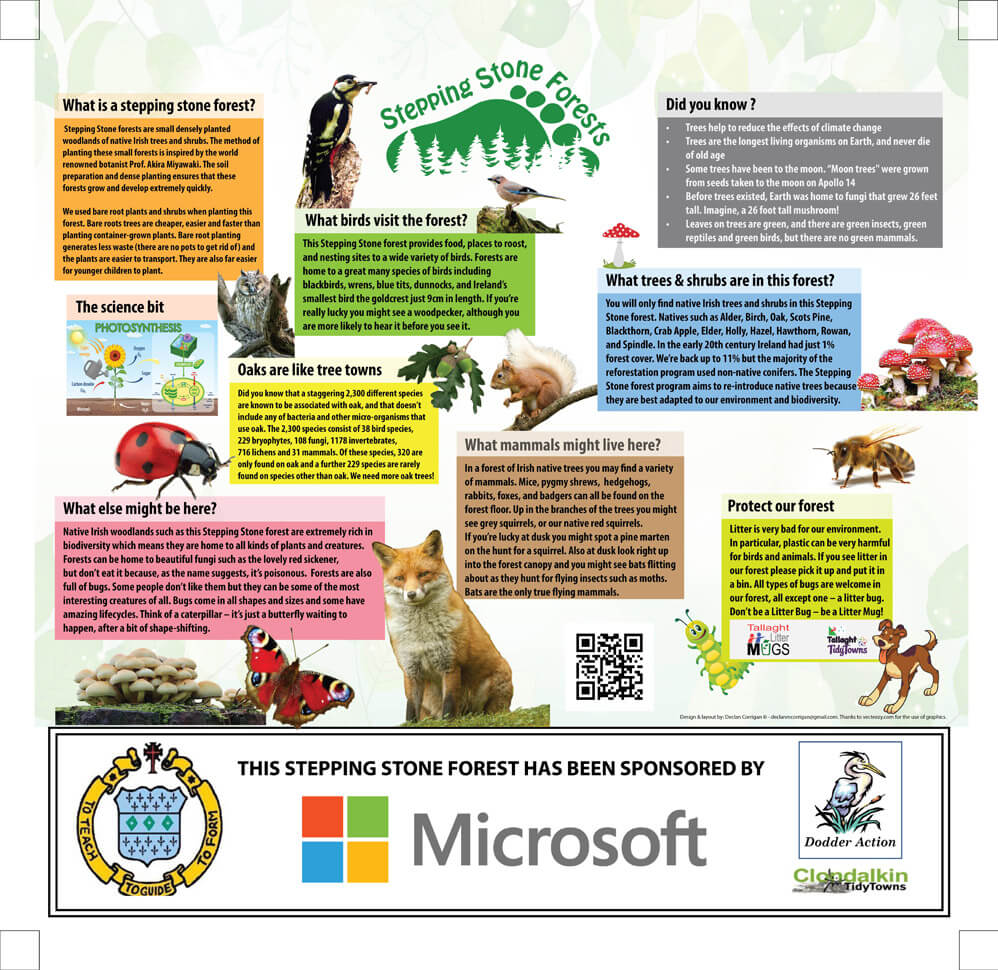
Photo acknowledgement: Stepping Stones Forests
- Primary, Secondary, General public
- Outdoor
- Gardening / school garden / allotment, Hands-on activity
- Ireland
Stepping Stones Forests
This community initiative founded in 2021 involves planting small, densely populated, urban woodlands of native Irish trees and shrubs in public parks, open spaces and school grounds in the greater Dublin area. These small dense mixed forests absorb over 30 times more carbon than grass lawns and help to mitigate climate change. Further, they can create cooler microclimates, with lower temperatures. As they can be planted in various urban settings, implementation in diverse environments is possible.
The Dodder Action Group are the main community organization involved and John Kiberd is the principal contact for the Stepping Stones Forests initiative.18 companies and several local community groups have supported the project to date. This is done through financial support to cover costs as well as volunteer hours to assist with planting. 28 schools and 6 parks have collaborated with the project so far.
Objective
Stepping Stones Forests want to provide natural oases for Irish wildlife and vital ecosystem services, including healthier soil, that also benefit humans. The aim is to have a series of closely located woodland wildlife corridors (stepping stones) across the greater Dublin area. Soil health and biodiversity awareness is a core principle as the first phase of planting involves preparing the soil by laying down cardboard and mulch and, after planting, infographic signage is used to enhance biodiversity awareness.
Approach
Prior to planting, the selected area is covered in a layer of cardboard and wood chip mulch to enrich the soil, help suppress weeds, retain moisture and to maintain a more even ground temperature. Approximately six months later, community volunteers or schoolchildren plant the trees and shrubs at a density of three per square metre. The only maintenance that is required is to ensure that the woodchip mulch keeps the weeds suppressed and to add an extra layer of mulch occasionally, if needed. After three years the Stepping Stones forest is self-sustaining requiring no further human intervention. The planting method used is inspired by an approach pioneered by botanist Prof. Akira Miyawaki. The dense planting allows the trees and shrubs to grow quickly.
The forests also have the potential for educational opportunities. Stepping Stones Forests promote this by providing a copy of the biodiversity book Wild Things at School by botanist Éanna Ní Lamhna to schools and by erecting biodiversity infographic signs at all locations. All materials and services used by them are sourced locally. These include the infographic sign images which were donated by a local wildlife photographer.