
Case study: Touring exhibition "The thin skin of Earth - our soils"
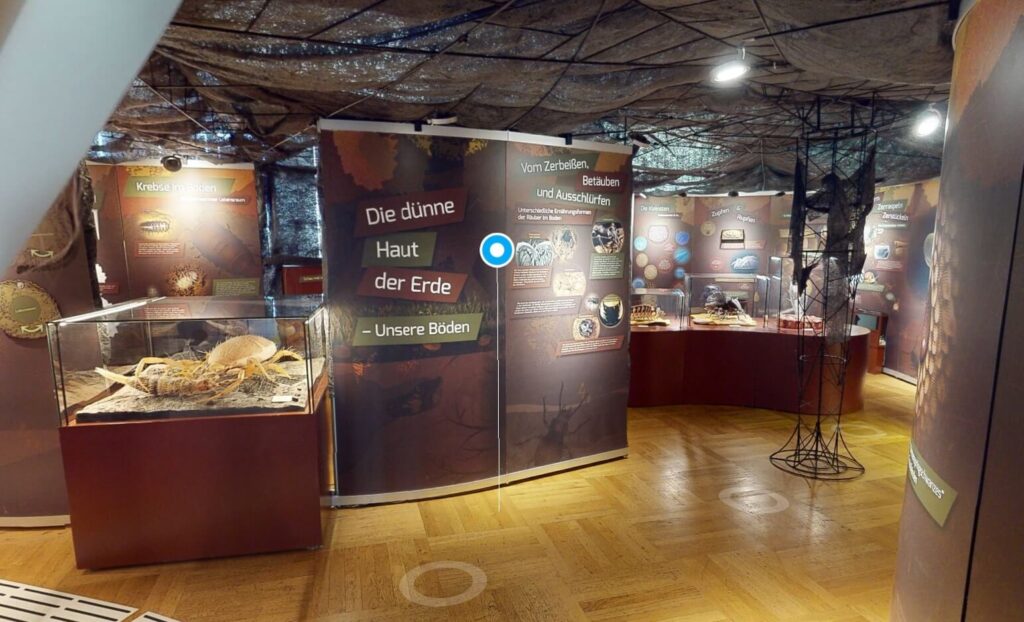
Photo acknowledgement: Sachsenhits VRmedia Niesky (Screenshot) https://my.matterport.com/show/?m=f42uyKowgXf&sr=-.54,1.24&ss=92
- General public
- Indoor
- Exhibition
- Greece
Touring exhibition “The thin skin of Earth – our soils”
“The Thin Skin of Earth – Our Soils” is a touring exhibition that delves into the world beneath our feet, showcasing the diverse organisms living in the soil and their beneficial impact on plants and humans. Recognizing soil as a valuable yet limited resource, the exhibition stresses the importance of protecting it and treating it in a sustainable manner. Despite this, human activity leads to the loss of fertile soil in Europe equivalent to the size of Berlin every year.
The exhibition has been The Senckenberg Museum conducts research on soil biodiversity and the functioning of soil organism communities to maintain essential soil functions and nutrient cycles.
Objective
The Senckenberg Museum created the touring exhibition to mark the “International Year of Soils 2015,” in which it presented aspects of soil, its organisms, and the current threats to soils. The exhibition not only highlights the significance of the “thin skin of the earth” and its ecosystem services but also offers solutions for its preservation. The aim is to showcase the exhibition in numerous museums around Europe, educating visitors about the living organisms in soils and fostering recognition of the soil’s value and relevance to humanity.
Approach
The exhibition provides visitors with an immersive experience through various tools such as 3D models, microscope images, hands-on exhibits, films, and multimedia devices of high quality. Visitors, metaphorically reduced to the size of an isopod, explore the unique zoology of soil organisms and learn about the soil’s diverse functions and properties, including organic matter recycling. Through virtual reality glasses, visitors can delve underground and encounter springtails, horned mites, white worms, and millipedes up close. Thanks to its flexible partition system in English and its use of diverse technical tools, the exhibition can be easily adapted and set up in various international locations.